Mondosuke ventures alone into the land of Nagasaki. There, he encounters young lady named Kinue, the daughter of Nagasaki's former magistrate office constable, Shusuke Kaneko. Monsuke has received information that Shusuke has been captured on charges of embezzlement, prompting him to head to the magistrate's office. However, the arrival of the Chief Inspector, Shigehide Ogiwara , obstructs Monsuke's actions.
When Jacob and his niece Piper are forced to move back to their old home, they slowly uncover the truth that the town has an ancient evil lurking in its Forest.
A section of the life of George of Poděbrady from his coronation to his death (1458–1471), creating a portrait of a remarkable monarch whose name shone as a symbol of Czech statehood, as a symbol of a victorious military leader and a prudent statesman; a powerful, complex and contradictory personality in the midst of a very dramatic fifteenth century. During thirteen years of independent rule, he wanted to defend with all his might what had been won by the Hussites; he wanted to defend it even in a time and environment that, on the contrary, wanted to settle accounts with the Hussites. It was during this tense time that Poděbrady's idea of creating an association of monarchs who would resolve conflicts through agreements and treaties, and not through war, arose. Even as a father, he made a sacrifice for his beloved country when he did not hand over the crown of the Czech king to his son, but to the Polish king Vladislav, the "Prince of Peace".
TV movie "Triptych of love" was created by short stories by famous Slovak writer Ladislava Nádaši - Jégeho. Historical themes in his works have an ambition to bring over to look attractive environment and time bygone era strong dramatic stories and exciting human destinies. Renaissance short stories from the collection "Italy" are a variety of views from different backgrounds, linking theme of many forms of love, its tones and semitones, from bitterly ridiculous after tragic. Screenwriter Ján Števček that dramatically processed three Jégeho stories.
Based on the real life events around Yevfimy Vasilyevich Putyatin, a Russian admiral noted for his diplomatic missions to Japan and China, and the signing of the Treaty of Shimoda in 1855.
The Polish city of Łódź was under Nazi occupation for nearly the entirety of WWII. The segregation of the Jewish population into the ghetto, and the subsequent horrors are vividly chronicled via newsreels and photographs. The narration is taken almost entirely from journals and diaries of those who lived–and died–through the course of the occupation, with the number of different narrators diminishing as the film progresses, symbolic of the death of each narrator.
1918, Castelao leaves his public position in Pontevedra to work as a doctor in Rianxo during the Spanish flu. A hero for the town, but an absent man for his wife, Virxinia. 1929, the couple travels through Britain a few months after the loss of their only son. Two broken beings and a bond that is no longer understood. A trip will unite them forever and ever. Castelao before being Castelao. Galicia before the “xeración Nós”. Castelao and Virxinia before being “we”.
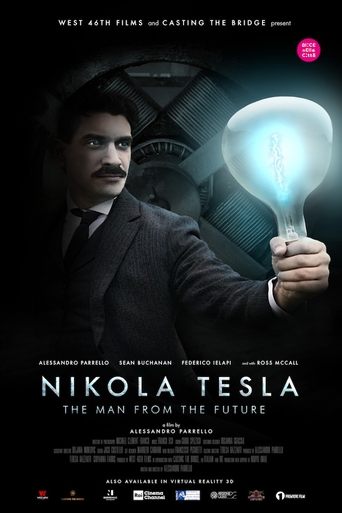
New York, May 16, 1888. Visionary Serbian inventor Nikola Tesla is about to introduce an innovative AC asynchronous motor. Before the demonstration, wealthy businessman George Westinghouse meets Tesla privately to get him to sell him his patent and go into business with him. Tesla declines the offer but during the demonstration something happens that will change the world forever.
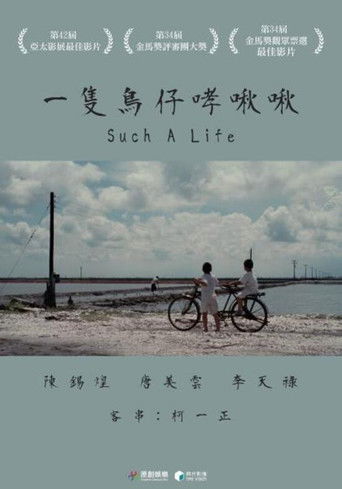
'Such a Life' is quite a sad film. It is set in the sixties, in a village on the west coast of Taiwan, where many are succumbing to 'black foot', a disease caused by drinking contaminated well water. The only 'cure' is to amputate the afflicted limb, and to avoid drinking the contaminated water. Many in the village were already sick, and few could afford to have tap-water installed. At the center of the story is Ah Chung, who lives with his grandfather, who has already lost one leg to 'black foot'. In the same village also live an opera family, who are finding things increasingly difficult there, an oyster farmer, who complains that his oysters are being poisoned by a nearby pharmaceutical plant, and an assortment of children who enjoy swimming in the sea, and who bully Ah Chung. A significant portion of the action also takes place in the village school, where Ah Chung is having trouble keeping up with the fees.
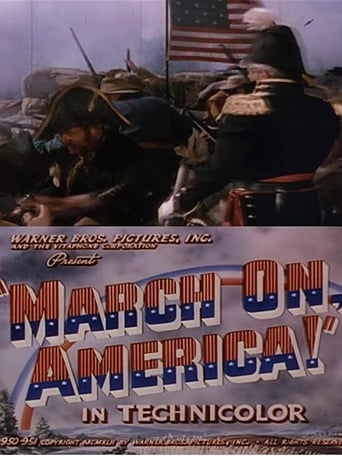
The story of America from the Pilgrims in 1620 to the attack on Pearl Harbor by the Japanese. Americans always working for freedom.
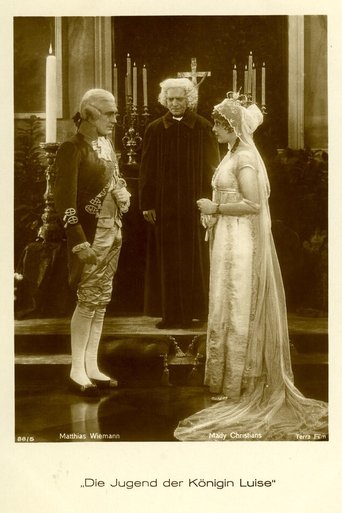
The young Crown Princess Luise of Mecklenburg-Strelitz grows up sheltered in the North German countryside in the late 18th century and develops into a bit of a rebel. She struggles to come to terms with the rules of etiquette at court; her actions are often spontaneous and driven by emotion. Thus, she resists accepting her father’s mistress and future wife. During a ball, she snubs her future stepmother and even has the audacity to ask the orchestra to play a waltz—a dance considered deeply improper at the time.
The history of the Yakuza Eiga at the TOEI studio is roughly outlined. Real Yakuza and also their connections to the movie business are discussed, and many important actors and directors of the genres are interviewed. Former real yakuza boss turned actor Noboru Ando, Takashi Miike, Sonny Chiba and many more get a chance to speak.
As a child, Sicilian Placido Rizzotto saw his father imprisoned for a crime he didn't commit, and as a young man he fought in World War II, first as a soldier and then as an anti-fascist partisan. These events have left Placido with little taste for petty tyranny and with a desire to promote social justice. Upon his return home, he becomes increasingly aware that the Mafia has taken hold of his village, witnessing angry and frustrated as gangsters control local politics and take whatever they want from the people. Placido helps to form a trade union as a challenge to the Mafia's authority, and attempts to organize the villagers into a collective to grow crops in the fields taken by the Mafia.
The year is 1941. Nazi Germany has declared war on the USSR and begins launching air assaults on Moscow and St. Petersburg. Stalin immediately orders a retaliatory air campaign under the code name “Wings over Berlin.” The closest entry point to Berlin from the USSR border was an airfield on the Estonian island Saaremaa in the Baltic Sea. It would be a 7-hour flight over enemy territory in outdated aircraft leaving no chance of survival for the tail crew members in case of attack. Despite overwhelming odds, the first units completed the mission and made it back to base safely, unlike many others that followed.
Every September Sydney's inner-suburban Leichhardt Council re-elects it mayor. Incumbent Larry Hand was popular with the citizenry but they don't vote for mayor - the 12 councillors do - and after three years of Larry, at least four councillors were after his job. When film-makers Bob Connolly and Robin Anderson settled in at Leichhardt Council in early 1994 the knives were already being sharpened. A battle royal was in the making, and so it came to pass. By the end of September Larry had fought the fight of his life, with Connolly and Anderson documenting every bit of it on film. Ambition, courage, envy, hatred, loyalty, betrayal, disaster, triumph... in other words, a classic study in politics.
Set in 1815, this is the dramatic story of a child of the fur trade, son of a Native mother and a Scottish-Canadian fur trader. John Mackenzie's father is a wintering partner of the Montréal-based North West Company, which was for decades the wealthiest merchant enterprise in North America. To mark his entry into adulthood, twelve-year-old John is travelling for the first time to Fort William, the Company's lavish winter headquarters by Lake Superior. In following his journey, the film reveals the complex network of people--Scottish, French and Native Canadian--that made up fur-trading society and gave a unique flavor to the opening up of Canada's northwest.
Jerzy Szajnowicz-Ivanov, the son of a Polish mother and a Russian father, raised in Greece, reports to the Carpathian Brigade in the spring of 1941. While the Poles are wary of him at first, he proves his worth by taking part in several sabotage actions against the Nazis.
A roman consul is sent to Gaul to investigate the theft of gold shipments. He discovers that the gold is being stolen by a tribe of barbarians — whose leader is the governor of Gaul.
Activate Your Account!
You must create an account to continue watching