Soviet WW2 film about operation that resulted in liberation of.Romania and Moldova from the Nazis.
Based on the famous story from the epic Shahnameh.
Inspired by "Voyage to the land of Brazil" by Jean de Léry, this short follows the adventures of Nicolas Durand, from Villegagnon, and the estabilishment of a French colony in 16th-century Rio de Janeiro.
Victim of a terrible plot, Captain Dreyfus was sentenced in December 1894 to deportation for high treason. His wife Lucie made a pact with him: to live, whatever the cost, while awaiting rehabilitation. During five years, the Dreyfus spouses exchanged hundreds of letters. They became a weapon of survival for Alfred. This film is the story of the correspondence of a man and a woman who unwittingly became the unsung heroes of the case that bears their name.
Mantralaya Mahatme is a 1966 Indian Kannada-language film directed by T. V. Singh Thakur, based on the book Sri Raghavendra Vijaya written by Rajaguru Rajacharya, and stars Rajkumar in the role of Raghavendra Swami, a Hindu saint who lived in the 17th century India
This John Nesbitt's Passing Parade short tells the story of John Peter Zenger, who in Colonial New York was tried for sedition based on what he printed in his newspaper.
Boris Zhadanovsky, a hereditary nobleman and officer who was predicted to have a brilliant military career, sides with the rebellious people. In 1905, Zhadanovsky is sentenced to death for his revolutionary activities. However, a powerful strike movement organized in response to the court's decision forces the tsarist government to commute the sentence to life imprisonment. After the revolution, Zhadanovsky joins the Red Army and dies fighting the White Army.
April 15, 1874, boulevard des Capucines, Paris: a group of young feverish painters shunned by the official Salon and mocked by the classical masters, chose to come together to exhibit their paintings freely, in the studio of photographer Nadar. At the end of a teeming century, when modernity was emerging, this group of rebellious artists, revolutionized the world of art.
Historical fiction drama set during the Indian Rebellion of 1857, also known as the First war of Independence.
According to the official history of Afghanistan, ruthless destruction has always prevailed over art and creation; but there is another tale to be told, the forgotten account of a diverse and progressive country, seen through the lens of innovative filmmakers, a story that survives thanks to a few brave Afghans, a small but very passionate group that secretly fought to save a huge film archive that was constantly menaced by war and religious fanaticism.
Evirati is a short film about a young woman who masquerades as a male castrato to sing in the opera houses of the Papal States at a time when women are forbidden from performing in public.
A biography of the famous Belarus poetess Larisa Antonovna Geniyush.
The end of Trajan's Dacian Wars (106 AD), when south western Dacia was transformed into a Roman province: Roman Dacia.
During WW2, in a Nazi-occupied country, a local partisan blows-up a German military train, prompting the Germans to take civilian hostages to be shot if the culprit doesn't surrender before a deadline.
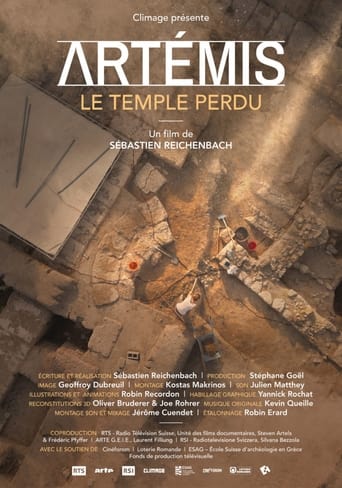
The location of the sanctuary of Artemis at Amarynthos has long remained one of the last great archaeological enigmas of Ancient Greece. This vast Artemision is mentioned in several ancient texts, which even go so far as to specify the distance that separates the sanctuary from the ancient city of Eretria. But despite the efforts of numerous scientific expeditions since the end of the 19th century, no trace of the sanctuary or its temple has ever been found. In the 1960s, a young archaeologist - Denis Knoepfler - set out in search of the lost temple of Artemis. His investigations soon led him into the hinterland of the island of Euboea, well beyond the limits of previous expeditions. It would take five decades of searching, unshakeable faith and moving tons of earth to finally unravel the mystery. In 2017, a tenacious Swiss-Greek team of archaeologists formally identified the sanctuary of Artemis, where Denis Knoepfler had predicted it lay buried.
On 16 July 1212, a Crusader army made up of Castilians, Aragonese and Navarrese (but also French, English and Germans) confronted the army of the Almohad Caliph an-Nasir at the foot of the Sierra Morena mountain range. The Battle of Las Navas de Tolosa, as the battle is known, is considered the most important battle of the Middle Ages on the Iberian Peninsula and is a key event in the history of Spain. More than 800 years later, a group of archaeologists and specialists have begun an archaeological study of the battlefield. Is everything that has been said about the battle true? What secrets does the terrain hide? And, above all, what can we learn today about events that took place hundreds of years ago and that pitted tens of thousands of people against each other in the south of our country?
After finding some relics in an open grave, two young siblings share an up-close experience with death at the cause of their own hand.
Activate your FREE Account!
You must create an account to continue watching