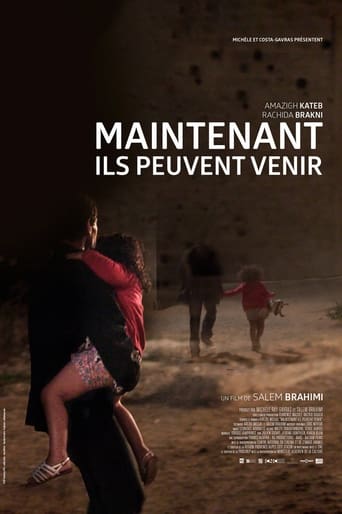
A story set in the Green Line in Nicosia, Cyprus, where a wall divides a country. Two soldiers, a Greek Cypriot and a Turkish Cypriot, decide to embark on a secret journey that is dangerous no matter which side you are at.
Banned in the Soviet Union for its "negative" content and never released, Kalatozov was forced to retreat from filmmaking for seven years because of this film. The film sets out to illustrate the old adage, "For want of a nail, the battle was lost," showing how the inferior quality of something so trivial as a nail in a soldier's boot leads inexorably to the capture of an armored train. Kalatozov had intended to demonstrate the crucial and universal importance of efficiency in Soviet industry, but the government decided that his fable gave a negative impression of the Red Army's capabilities.
Immediately after the war, OZNA insert an outstanding intelligence agent to catch the General Draza Mihajlovic.
Denise lives with her grandparents on a farm and secretly meets Robert. When she tells her grandparents that she wants to marry Robert, they refuse outright, so the two lovers will have no choice but to elope and marry in the nearby town. On the eve of having a child, war breaks out and Robert is mobilized.
An officer in his secret mission to India is injured by foreign agents. He returns to Greece but must be considered dead by his wife for the needs of the service, since he must discover who betrays the state secrets.
After studying Central female school where learner was trained as a spinier, in 1943 Aliya joined the Soviet armed force with her girlfriends .She shot an German sniper who killed many Soviet soldiers in an fighting action.
Svitlana, a Russian-speaking Ukrainian, examines the colonised part of her consciousness and tries to find answers to the question of how Soviet totalitarianism and Russification influenced the relationships within her family.
In 1925, with the cooperation of the War Office, British Instructional Films set out to make a dramatic, feature-length reconstruction of the five Ypres battles in which 1.7 million soldiers lost their lives. Directed by William Summers, the result is a silent classic. Unlike the famous 1916 documentary The Battle of the Somme, the Ypres footage is entirely ”faked” and the film shares some of Somme‘s propagandist approach. Regardless, the film is no less fascinating as an artistic endeavour of its time and it features some stunning images. A degree of authenticity is provided by real soldiers taking part and by the filming having taken place in the actual Ypres trenches.
Two POWs - Russian and Lithuanian - are trying to escape a German Camp during WWII.
March 1945. It is already quite obvious to the Nazis that they cannot win the war. So it is time to think about the future after the war and to cover their tracks. One concentration camp must be completely cleared out and the prisoners buried in the mines. Only the mine-hunters remain - among them Ernest, a veteran of the Spanish Civil War from Vienna, and Kim, a resistance fighter from Prague. One day they decide to escape with the other prisoners, but they are betrayed and most of the escapees are shot. The pair of heroes are not alone, however, and on the way they are joined by a guard dog from the camp that Kim used to feed. In the coming days, Ernest leads young Kim through the unrelenting cold on his journey to freedom, teaching him that there is only one rule to follow in this time - kill or be killed.
At the turn of 1990 in Algeria, in an end-of-era atmosphere marked by the victory of the Islamists in the municipal elections, then in the interrupted legislative elections of 1991, a prelude to a decade of particularly barbaric violence, the Algerians will experience the radical Islamism, its desire to rule public and private life and a daily life of attacks, assassinations, then collective massacres, which left 200,000 dead. Literature and cinema have strived to question and bear witness to the enormous trauma of this period called the “black decade”.
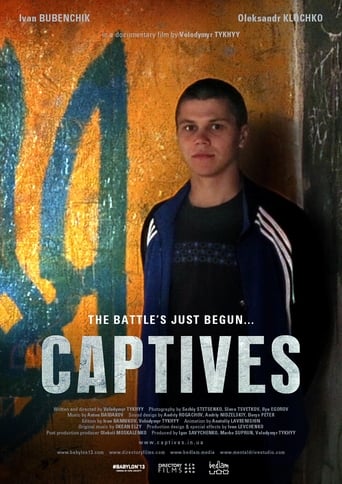
The search for a government soldier taken captive on February 20, 2014 in Kyiv takes protester Sashko to the front lines on the East of Ukraine. There he meets Ivan, a Ukrainian volunteer harbouring a secret that could undermine a fragile cease-fire…
This very brief cartoon from Japan whose title translated means "The Monkey Fleet" and runs little more than a minute has the Asian monkeys battling octopuses as they both go underwater with the simian animals riding in submarines shooting their torpedo bullets at the sea creatures.
The final months of World War II. The fate of a young girl, Second Lieutenant Horak, and an experienced frontline officer, Lieutenant Colonel Kaszyba.
Evocation of a dramatic episode of the Second World War told by an old guard. Boarded as a non-commissioned officer on the battleship sailed from Pola and headed south. In time of danger, the man is forced to sacrifice the lives of seven sailors and the son of the Captain, his good friend, in order to save the rest of the crew.
1940. Victor Leizer, a young Jewish boy from Belleville, takes to the road to join his parents. There he meets Bernard Mirande, another young boy. But after being captured by the Gestapo, he is sent to the camps, where he becomes Commandant Braumann's scapegoat. But his adventures are just beginning...
The film tells that in 360 BC, the capital Yecheng was captured by Wei State. Assassins Lei and Jingchan failed to assassinate King Wei and died. Hao Xue escaped and found Mi Zheng, the exiled prince of Chu. He also sent assassins to look for Mi Zheng, and he was about to cut the grass and root out. The story of whether Chu State could recover the country without a trace of shame.
Extremely personal film based on facts. The trial in the US to arrest a Nazi criminal becomes an opportunity for insightful observation of human behavior, the human psyche. And there is some truth in the heroine's words that the law protects the perpetrators, not the victims....
Activate your FREE Account!
You must create an account to continue watching