The movie addresses the anti-fascist theme taken from a moral perspective. The movie tells the story of a group of teenagers who were drafted to the front in the last weeks of World War II and found refuge on a small island.
Jesus Christ goes from being born in a manger to being King of the Jews . Walk where he walked, see what He did, and be where He died. What made him more than just a man in some peoples eyes but an impostor in others'? ...
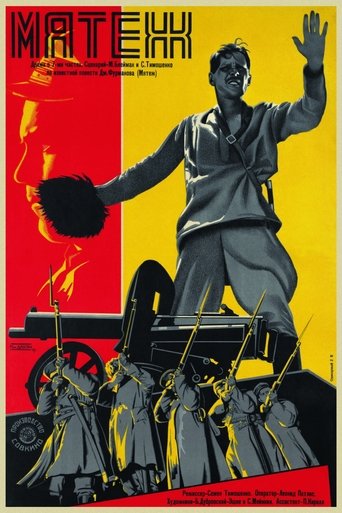
A 1935 USA trade-paper reviewer called it... "an impressive and technically outstanding historical drama dealing with czarist terrorism and revolutionary boiling in the days of 1907. Picture is one of the Soviet prize winners and has particular merits in realistic performance, photography and movement, plus some musical touches in way of folk songs."
Summer, 1944. A military airbase near the very front-line. A young soviet pilot Sergey makes his first practice flight. In the course of this flight he hears a call for help on the radio from Russian pilots, having an unequal air combat with superior forces of the enemy. Sergey rushes to their rescue. His plane gets shut down, and he is taken prisoner. Soon he is taken to a special flight school, where future German aces are prepared and Russian pilots at the wheel of captured Russian aircrafts are used as living targets. Nobody wants to put up with such situation, and they prepare an escape.
During the Second World War, the Germans hunt an Italian partisan who is trying to blow up a chemical weapons laboratory.
The legendary spy obtained as much secret information as no one else could. For this, he paid with his own life.
Fritz Schmenkel, a farm worker and soldier in the fascist Wehrmacht, deserts in Belarus in 1941. He wants to survive, makes his way to Russian farmers and comes into contact with Soviet partisans who, after long interrogations by the German teacher and current partisan Miron, take him in as one of their own. Schmenkel proves his reliability in a number of daring actions and is awarded the Order of the Red Banner. In the winter of 1943/44, he is given a reconnaissance mission and falls into the hands of the fascists in Minsk. After days of interrogation, which he withstands, the Nazis execute him.
Silently conveys a couple's fear of an immanent nuclear blast. Part of Sweet Disaster; a 1986 series of short films made for Channel 4. It consists of “animated visions of the apocalypse”.
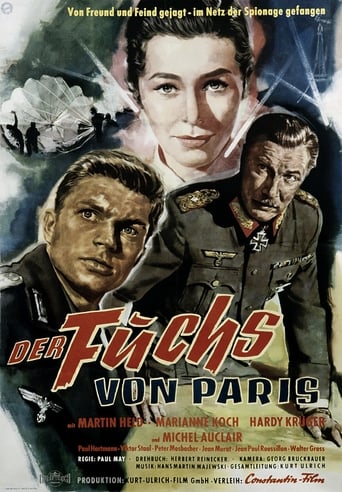
Paris, 1944. With France under Nazi occupation, General Quade entrusts an important mission to Furstenwerth, the commander of the Wermacht: to secretly transmit secret documents to the Allies. While carrying out this mission, the commander falls under the spell of a young French resistance fighter, Yvonne. He is discovered and arrested by the Gestapo. Yvonne and her group of resistance fighters will do everything to free him.
A story about the boys and their life during the WWII. Based on Lev Kassil book.
Central Asia during the Civil War. The Jarkent battalion of the Red Army, located in the Verny (now Alma-Ata), receives an order from Frunze to go to the Fergana region to fight the Basmachi. A group of kulaks, with the support of local merchants and beys, incites the unconscious, wavering mass of the Red Army to revolt. The anti-Soviet agitation of counter-revolutionaries, demagogically exploiting the mood of war weariness, provokes an open mutiny in the battalion.
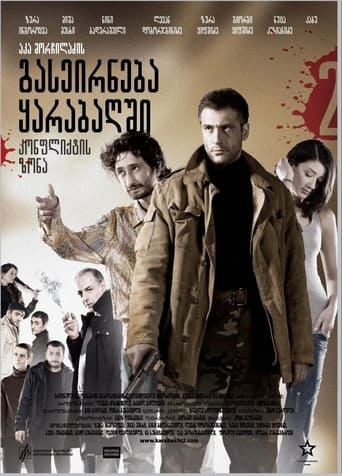
The Soviet Union has collapsed. Civil and ethnic wars have broken out in Georgia, Azerbaijan, and Armenia, three republics in the Caucasus. The post-Soviet Caucasus have turned into one large conflict zone. Two radically different people with different ideals, problems, and goals are united by the conflict zone. Gogliko, a Tbilisi street boy, and Spartak, a Sukhumi sniper, are forced to solve problems of the street and problems of the state together. For one, the goal is to get back the money he lost gambling; for the other, it is to carry out a general's absurd military mission. In spite of it all, their paths cross and their lives are changed forever.
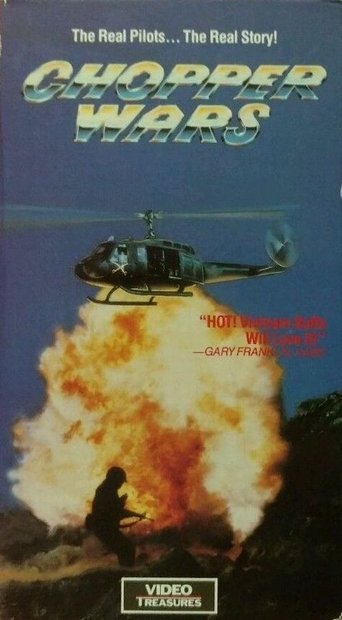
Fly low, blasting everything in front of you to pieces was one version. The other was send light helos, like the Loach, teamed up with two gunships. Together known as "Pink Teams" they would fly low trying to draw enemy fire. When the V.C. opened up, the gunships would strike quickly with rockets and machine guns. The tactic known as Recon by Fire is just one of the operations you will experience firsthand in "CHOPPER WARS." It is a story about one of the most devastating weapons used in the Vietnam War, the Viet Cong's worst nightmare--the helicopter. "To the grunts, they were a godsend--to the enemy they were beasts from Hell--the "CHOPPERS!" -insane copy from the back of the VHS box.
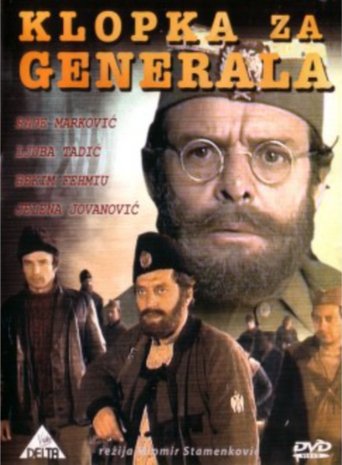
Immediately after the war, OZNA insert an outstanding intelligence agent to catch the General Draza Mihajlovic.
A Soviet documentary chronicling a single day of the Great Patriotic War—June 13, 1942, the 356th day of the conflict. Filmed simultaneously across all fronts and the home front by 160 newsreel cameramen, and edited by Mikhail Slutsky at the Central Studio of Documentary Films, it offers a sweeping portrait of total war. Released in October 1942, the project captured the Soviet struggle against the German invaders in a single, coordinated day of filming.
This epic traces, from the Beginning, the lineage of the race of peace-loving people. Mankind at its best is highlighted as greatness of character across the centuries is displayed: Noah heeding God's command, Moses leading the Israelities, Jesus Christ dying to save humanity and promote His message of peace. Moving into our modern epoch: Columbus's discovery of America, the Declaration of Independence, the Emancipation Proclamation; A race of free humans committed to the proliferation of peace and freedom. What becomes of this race when autocratic powers threaten democracy in the time of the first World War?
During World War II, the Canadian Navy gathered a troupe of diverse performers (dancers, comedians, singers, musicians) from its ranks and sent them off to entertain their shipmates, and the show/revue ultimately played London's Hioopodrome. The acceptance was based more on wartime-London's appreciation of the gallantry of Britain's sons and daughters from over the seas than it was on the artistic value of the show or the talent of the performers. The film is a fictional/fact mixture of the adventures of the troupe members, and the ending, only part filmed in Technicolor, is primarily the Revue as seen at the Hippodrome.
Activate your FREE Account!
You must create an account to continue watching